Don't Bust Your Bankroll: The Money Management Playbook Serious Bettors Swear By
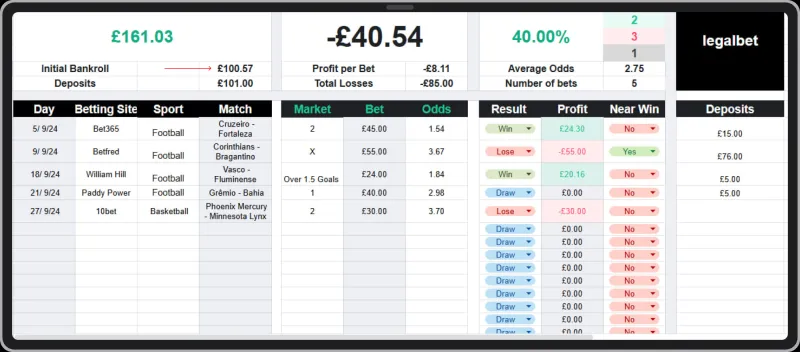
Photo: sports betting spreadsheet bankroll management money chips, via static.legalcdn.org
Here's a truth that doesn't get said enough in betting circles: you can be right more often than you're wrong and still go broke.
Wild, right? But it happens constantly — to casual bettors and even to people who genuinely know their stuff. The culprit isn't bad picks. It's bad money management. And at IconWin999, we think that's a fixable problem.
This isn't a piece about finding winners. It's about surviving long enough to let your winners work for you.
The Bankroll Is the Business
Professional bettors — the kind who do this for actual income — think about their bankroll the way a small business owner thinks about operating capital. You don't blow your working capital on one big swing. You protect it, deploy it strategically, and make sure you're still open tomorrow.
Start by defining your bankroll clearly. This is money that is completely separate from your rent, your groceries, your emergency fund. It's your betting capital, and it lives in its own mental (or literal) account. Once you blur that line, you're not betting anymore — you're gambling with money you can't afford to lose, which changes every decision you make in ways that hurt you.
Most serious bettors recommend starting with a bankroll you could lose entirely without it affecting your life. That number is different for everyone. What matters is that it's real, it's fixed, and it's protected.
Unit Sizing: The Foundation of Everything
Once your bankroll is defined, the most important concept you'll learn is unit sizing.
A unit is simply a standardized bet amount — typically 1% to 5% of your total bankroll. If you're working with a $1,000 bankroll, a single unit might be $10 to $20. Most sharp bettors stick to the conservative end: 1% to 2% per unit.
Why does this matter so much? Because it protects you from variance.
Let's say you're a solid bettor hitting 55% of your NFL picks — genuinely impressive in a sport where breaking even requires about 52.4% at standard juice. Even at 55%, you will have losing weeks. You'll have stretches where you go 3-8 or worse. That's not a crisis — that's variance. But if you're betting 20% of your bankroll per game, a bad week can wipe you out before the math has a chance to work in your favor.
With 1-2% units, a rough stretch is uncomfortable, not catastrophic. You live to bet another week.
The Kelly Criterion: Sizing Bets Like a Mathematician
If you want to go a level deeper, look into the Kelly Criterion — a formula developed in the 1950s that calculates the optimal bet size based on your perceived edge.
The simplified version: Kelly % = (Edge / Odds)
So if you think a team has a 60% chance of winning and the sportsbook is offering even money (implied 50%), your edge is 10%. Kelly says bet 10% of your bankroll.
In practice, most serious bettors use a "fractional Kelly" approach — betting half or a quarter of the full Kelly recommendation. Why? Because the formula assumes you know your edge precisely, and overconfidence is a real problem. Half-Kelly gives you most of the mathematical benefit with significantly less risk of ruin.
You don't need to run Kelly calculations on every bet. But understanding the logic behind it — that bet size should scale with your actual edge — keeps you from overbetting marginal situations and underbetting your strongest plays.
Loss Limits and Session Rules
Even the sharpest bettor in the room can tilt. Maybe you took three bad beats in a row. Maybe a backdoor cover cost you a parlay. The emotional response is to fire bigger on the next game to get even — and that instinct will absolutely destroy your bankroll over time.
This is why pre-set loss limits are non-negotiable for anyone serious about longevity.
Here's a practical framework:
- Daily loss limit: Stop betting when you've lost a set number of units in a single day. Many sharp bettors use 3-5 units as their ceiling.
- Weekly reset: Review your results weekly, not daily. One bad day doesn't define your strategy.
- No "chase" rule: If you're down, you do not increase unit size to recover losses. Period. This is the rule most bettors know and still break. Write it down somewhere visible.
Casino players can apply the same logic. Set a session buy-in limit. Set a loss walk-away point before you sit down. When you hit it, you leave — not after one more hand, not after the next spin. You leave.
Tracking: The Habit That Separates Amateurs from Pros
You cannot manage what you don't measure.
Every serious bettor keeps records. Not in their head — actual records. A spreadsheet works fine. Log every bet: the game, the line, your unit size, the result, and your running bankroll total.
After a few weeks, the data tells you things your memory never will. Which sport are you actually profitable in? Which bet types are bleeding you dry? Are you better early in the week when lines are fresh, or later when you've done more research?
This kind of self-analysis is where recreational bettors leave real money on the table. They remember their wins vividly and undercount their losses. A spreadsheet doesn't have that bias.
The Psychological Side of Staying Solvent
Money management is partly math and partly mental discipline — and honestly, the mental part is harder.
A few habits worth building:
Separate your identity from your results. A losing week doesn't make you a bad bettor. Variance is real. Judge yourself on process — did you make good decisions with the information available? — not just outcomes.
Don't bet to entertain yourself. This one's sneaky. Sometimes you'll place a bet not because you have a real edge, but because you want action on a game you're watching. Those bets are fine occasionally, but they should be small, clearly labeled in your mind as entertainment spending, and never confused with your serious plays.
Take breaks after big wins too. Overconfidence after a hot run is just as dangerous as desperation after a cold one. Stick to your unit sizes regardless of how good things feel.
Your Edge Is Only as Good as Your Staying Power
At IconWin999, we talk a lot about finding your edge — and that's real. Sharp lines, smart research, and understanding value all matter. But none of it counts if you're not around long enough for the edge to pay out.
Bankroll management isn't the exciting part of sports betting or casino play. It doesn't make for great highlight reels. But it's the difference between the bettor who's been grinding profitably for three years and the one who had a great October and then disappeared.
Protect the bankroll. Size your bets with discipline. Know your limits before you need them. That's how you stay in the game — and staying in the game is how you win it.